The story behind it
The interview happened in a coffee shop in Yasothon, in Thailand’s north-east. It was one of those days that makes a cyclist restless — heavy cloud over the sun, no rain, a cool wind, almost no traffic and a wide shoulder on the road. The writer noted, a little ruefully, that it was perfect riding weather and he had come by car.
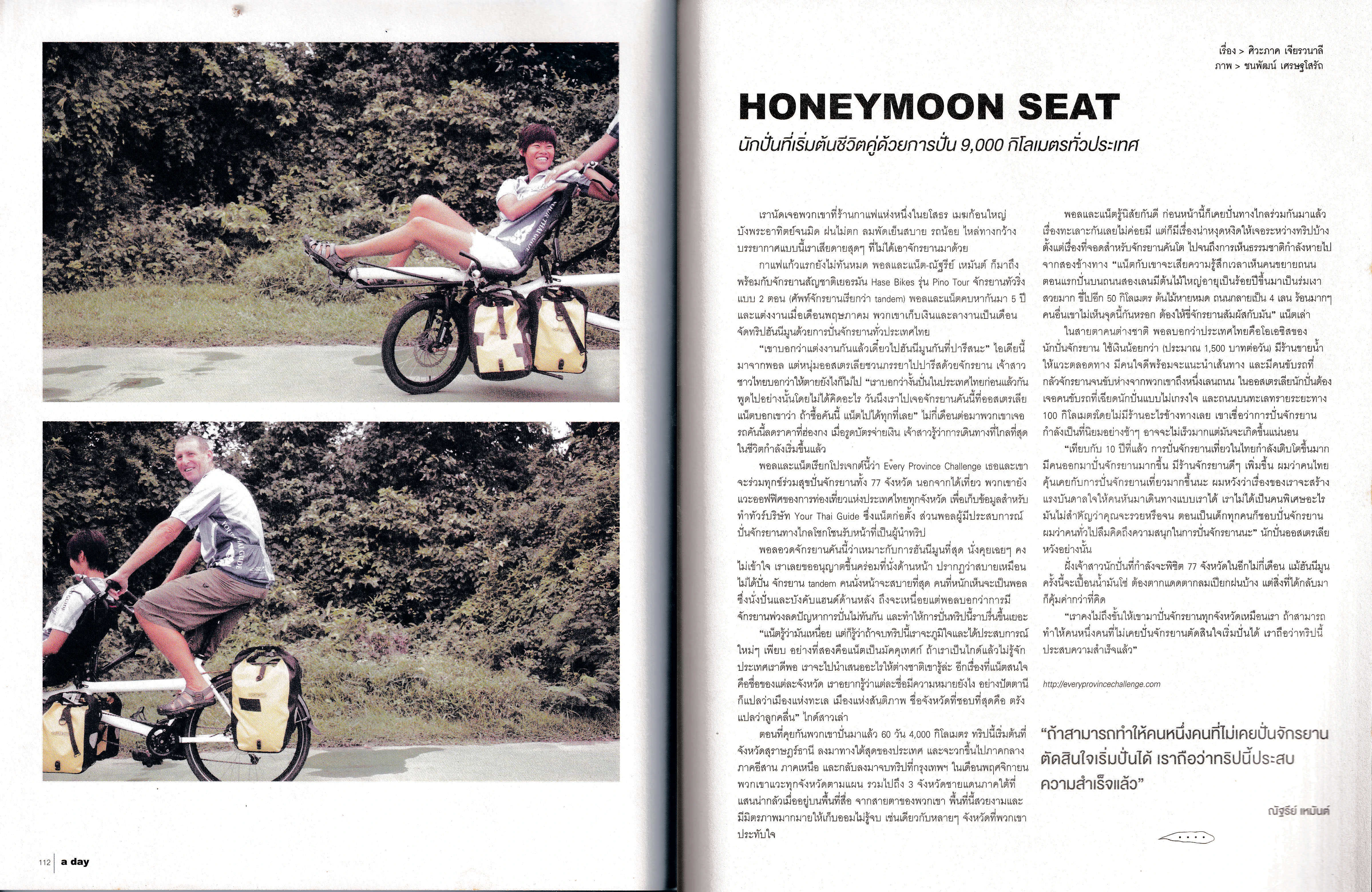
We rolled up before the first coffee was finished, on a German-built Hase Pino Tour: a tandem where the front rider sits low and reclined with their feet out ahead, and the rear rider steers. We had been together five years and married in May. The plan for the honeymoon was to save hard, take a month off, and ride around Thailand.
How the bike got bought
It started as a joke about Paris. Paul suggested a honeymoon there — then suggested riding there, which Natt refused outright. Thailand first, then, he said, not really meaning anything by it. Some time later they came across the Pino in Australia, and Natt’s position shifted: buy that bike, she told him, and she would go anywhere on it. A few months after that they found one discounted in Hong Kong. The card went through, and the longest journey of her life was booked.
Every Province Challenge
They called the trip the Every Province Challenge: all 77 provinces, on one bicycle, together. It was not purely a holiday. In each province they called in at the Tourism Authority of Thailand office to gather material for Your Thai Guide, the tour company Natt had founded, while Paul — by then a long-distance cyclist with a lot of hard kilometres behind him — ran the trip itself.
Paul’s claim was that the Pino is the ideal honeymoon machine, which is difficult to argue about over coffee, so the writer asked to try the front seat. His verdict: startlingly comfortable, barely like riding at all. That is the point of the layout — the front rider gets the easy end of the deal and the rear rider does the steering and most of the work. The compensation is that a tandem removes the problem that separates couples on two bikes, where one is always waiting for the other. Nobody gets dropped.
Natt’s reasons were her own. She knew it would be exhausting, and expected to finish it proud and better travelled. She also made a professional argument: a guide who does not know her own country properly has nothing to offer visitors. Along the way she collected the meanings of province names — Pattani read as a city of sea and peace; Trang, her favourite, as waves.
Sixty days in
At the time of the interview they were sixty days and about 4,000 kilometres into it. The route had started in Surat Thani, run down to the southern tip of the country, and would then swing up through the centre, the north-east and the north before finishing in Bangkok in November. They rode every province on the plan, including the three southern border provinces that look frightening from a distance in the news. Up close, on a bicycle, they found them beautiful and full of the sort of small kindnesses that accumulate over a long trip.
Not everything was easy. There was the daily problem of parking an oversized bicycle. And there was the road-widening: starting the morning under century-old trees on a two-lane road, and finding fifty kilometres later that the trees were gone and the road was four lanes of heat. It is the kind of change, Natt observed, that you only really register at cycling speed.
Thailand from the saddle
Paul’s verdict, as a foreigner, was that Thailand is something close to an oasis for touring cyclists — cheap to travel in at around 1,500 baht a day, drink stops everywhere, people happy to point you the right way, and drivers who give a bicycle most of a lane. He compared it with riding in Australia: drivers who pass close enough to make the point, and hundred-kilometre stretches of desert road without a shop of any kind.
He thought Thai cycle touring was growing — more riders out than a decade earlier, more good bike shops, more people for whom the idea was no longer strange. Not a boom, but a change that would stick. And his pitch was deliberately unglamorous: they were not special, it had nothing to do with money, and every one of us liked riding a bike as a child before forgetting that it was fun.
The piece closes on Natt, with the remaining provinces still ahead of her, a honeymoon of chain grease, sun, wind and rain behind her, and a very modest definition of success:
“ถ้าสามารถทำให้คนหนึ่งคนที่ไม่เคยปั่นจักรยานตัดสินใจเริ่มปั่นได้ เราถือว่าทริปนี้ประสบความสำเร็จแล้ว”
“If we can get one person who has never ridden a bicycle to decide to start, we’ll consider this trip a success.”
Natt Hamon — ณัฐรีย์ เหมันต์, quoted in a day 145